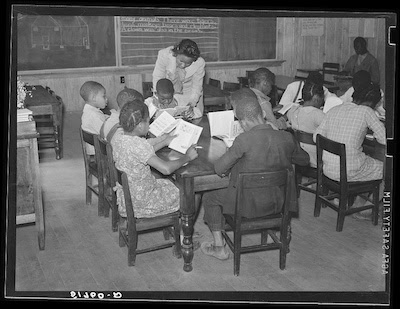
Issue 56 of the Bank Street Occasional Paper Series, “Recovering and Reclaiming Black Histories: Integrating Historical Perspectives in Teaching and Research,” explores the histories, experiences, and contributions of Black educators and communities across the African diaspora and Global South. The issue invites readers to consider how recovering histories that have been overlooked or erased can deepen our understanding of education and help shape its future.
In the conversation that follows, guest editors Mariah Harmon and Taryrn T.C. Brown highlight traditions of Black educational agency, creativity, resistance, and community-building. They hope these histories can serve as resources for educators and researchers navigating the present and imagining more just educational futures.
Q: What do you hope this issue will bring to the conversation about Black educators and their contributions to education?
A: We hope this special issue enriches the conversation about Black educators and their contributions in education. We feel this highlights the urgent need to recover and reclaim Black educational histories that are often obscured, fragmented, misrepresented, or absent in traditional archives and the wider historical narrative. As we sit with the collective insights across the manuscripts of this special issue, we hope that readers will journey across Black navigations of the sociopolitical contexts that have influenced schooling for Black communities, the spaces of learning and networks of negotiation that were developed to maintain educational access for teachers and students, and the approaches to curriculum and pedagogy used in past and present that have supported students toward greater educational equality and justice. Extending the work from Dillard’s (2021) endarkened feminist praxis framework through (re)searching, (re)envisioning, (re)cognizing, (re)presenting, and (re)claiming to reimagine educational futures, this issue for us is the needed ongoing conversation that re-centers the Black educational experience at the heart of future-casting across the educational landscape.
Q: What does it mean to “recover and reclaim” Black education histories, and what can this work offer us in the current educational landscape?
A: Collectively, across this special issue we position archival and historical inquiry not simply as acts of looking backward, but as critical practices of recovery and reclamation that can shape how we understand Black educational life in the present. We hope that, in this issue and through attending to the people, places, institutions, movements, memories, and everyday practices that have sustained Black education across generations, we can broaden what counts as an archive, whose knowledge is recognized as historical evidence, and which methodological approaches are necessary for telling more complex histories of Black education. Considering contributions to educational research, this issue operationalizes and offers the language that complements our ideas for recovering and reclaiming Black educational histories. The papers provide insight into historical inquiry as an avenue for acts of resistance that refuses to ignore the silences currently in the archives and as a result of the current political commentary that seeks to strip and reduce historical record even further. The authors in this issue share testimony and witness through their work from their own lives, the lives of educators who came before them, and the histories of spaces for Black education across the diaspora. As readers, we hope this work can inform the current educational landscape as we call you to bear witness to these histories as our call to action.
Q: The call for papers emphasizes stories, strategies, and pedagogies that have often been overlooked or left out of traditional educational histories. What kinds of perspectives or stories do you hope this issue will bring to the forefront?
A: Ultimately, we do hope this special issue will demonstrate how reclaiming Black educational histories will bring to the forefront and show an offering of critical resources for understanding contemporary educational inequities, while also illuminating longstranding traditions and experiences of Black educational agency, imagination, pedagogies, space-making, resistance, institution-building, and possibility. Across the papers in this issue and thematically, we have captured stories of Black education as a liberatory project rooted in memory, community, and place; stories that honor our past and reimagine educational futures; methodological expansions in Black educational research; and expansions in who constitutes Black teacher. Through these themes and in the throughline, we hope this issue brings to the forefront that these works should not only disrupt the correction to historical erasure experienced by Black histories, but also position historical recovery as an intellectual inheritance for contemporary education praxis and educational research. We want the readership to not only consider what has been left out, but also what we learn as educators when recovered Black educational histories teach us about what education has been and what it might become.
Q: The issue looks beyond the United States to consider Black educational histories across the African diaspora and the Global South. Why was it important to take this broader perspective?
A: It was essential to take a broader, global perspective because Blackness extends far beyond the United States. Dominant historical narratives, shaped by colonization and Eurocentricity, have positioned Western contexts as the default framework for understanding education. By looking across the African diaspora and the Global South, this issue intentionally disrupts that narrow lens and challenges the idea that the United States is the primary site of educational leadership and innovation. Centering Black educational histories globally allows us to recognize shared conditions, distinct contextual practices, and diverse forms of resistance and creativity among Black educators. This expanded view not only deepens our understanding of teaching and learning but also invites educators and researchers to imagine new possibilities beyond geographic boundaries.
Q: What can educators and researchers today learn from the histories and practices of Black educators, particularly as they navigate the current sociopolitical landscape?
A: Historically, Black educators have weathered inequitable and violent sociopolitical climates. Black teachers have had to be creative, resourceful, resilient, and transformative in order to respond to the needs of their communities that were often impacted by systemic racism. When there was no funding for school buildings, Black teachers taught in churches and other communal spaces. When Black students were not permitted to participate in activities in segregated space, Black teachers created extracurricular programming to give students additional opportunities. When educational policies created barriers for the success of Black students, Black teachers organized, protested, and fought for students’ rights. Black teachers have never opted out or retreated because times were difficult. We hope that educators and researchers today will look to these stories as inspiration for possibility. Although we are operating in difficult times, that does not mean the work stops and it certainly does not mean we quit. This is the time that we tap into our creativity, fugitivity, and bravery to serve as advocates for our students. This issue provides many examples of Black teachers using the tools around them to better reach their students providing them with pathways forward.
Mariah Harmon, PhD (she/her), is an assistant professor of teacher education in the College of Education at Penn State University. Taryrn T.C. Brown, PhD (she/her), is an assistant professor in the College of Education at the University of Florida.