Issue 56
Recovering and Reclaiming Black Histories: Integrating Historical Perspectives in Teaching and Research
Introduction
by Mariah Deans Harmon and Taryrn T.C. Brown
An Invitation to Remember
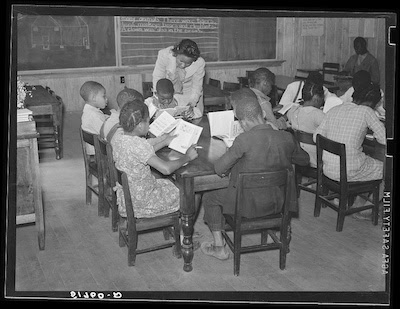
Part of classroom with teacher, Prairie Farms, Alabama. Photograph by Marion Post Wolcott, March 1939.
During one of our many virtual writing sessions–spaces that for us had become as much about thinking and collective sensemaking as they were about writing–Taryrn shared plans for an upcoming research visit to Zimbabwe. Supported by an International Center Global Fellows grant at her institution, the research visit was intended to extend her existing research agenda into a more explicitly global and transnational context. Yet, as our conversation unfolded, what began as a discussion of an upcoming research experience deepened into reflection on place, memory, family, and the histories that accompany us into our scholarly work.
In sharing this exciting project, Taryrn told Mariah about her grandparents, Violet Chemwandoita and Josiah Njagu, who were educators in Zimbabwean mission schools pre- and post-independence from the late 1950s through the 1980s. As Taryrn shared about her Mbuya (“grandmother” in the Shona language) Njagu’s experiences, Mariah noticed many similarities between Mbuya Njagu’s and her own grandmother’s story. Mariah excitedly shared that her grandmother, Julia Bowen Williams, was also an educator in Okolona, Mississippi during the same time period. In sharing our grandmothers’ stories, we realized that even though our grandmothers grew up, taught, and navigated two different geographical locations, they were connected through the legacy of Black women educators across the diaspora, which connects Taryrn and Mariah today as Black women educators in the same lineage. Our initial conversations pushed us to keep asking questions in pursuit of our grandmothers’ stories, providing a blueprint for pedagogies informed by the past, the present, and hopes for the future.
As we offer insight into how we entered this work, we recognize historical inquiry as a powerful methodological orientation for recovering, preserving, and reinterpreting histories too often fragmented, silenced, or rendered peripheral within dominant educational narratives. We do not position ourselves as educational historians, nor do we claim historians’ disciplinary expertise. Rather, we approach this work as educational researchers who recognize the intellectual and methodological strength of historical inquiry, and particularly Black archival practices, for understanding how the past remains present in educational lives, institutions, and possibilities. In this way, we use historical methodologies as generative tools to trace memory, recover knowledge, and illuminate the continuities, ruptures, and futures that shape Black educational experiences. Education is never ahistorical; stories of Black educators, Black education, and diasporic inquiry over time should be highlighted as guides for future practice, and this belief underpins this special issue. We were overwhelmed by the interest we received from scholars, activists, educators, and community members considering contributing to this special issue. While we could not accept every submission, the power in every story we reviewed strengthened our resolve to build an archive curated for us, by us. As Black folks, we oftentimes have to create our own homeplaces where our excellence is celebrated and uplifted, and we have taken great honor in doing just that in this special issue.
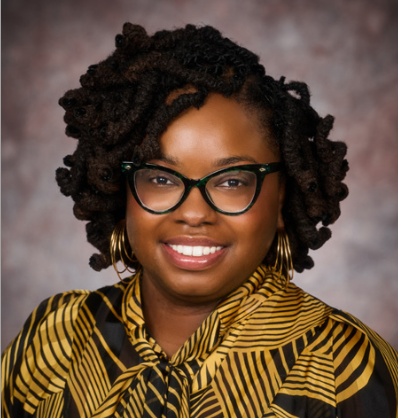
Mariah Deans Harmon, PhD (she/her), is an assistant professor of teacher education in the College of Education at Penn State University. As a member of the Department of Curriculum and Instruction, her research centers on strategies to make teacher education programs more inclusive, specifically considering the needs of Black teachers. Before working in academia, Mariah was a middle school English/Language Arts Teacher in Okolona, Mississippi, teaching in the same school as her grandmother, Julia Bowen Williams, 40 years before. This connection has been a driving force for her engagement in the histories of Black teachers as a blueprint for pedagogical development today.
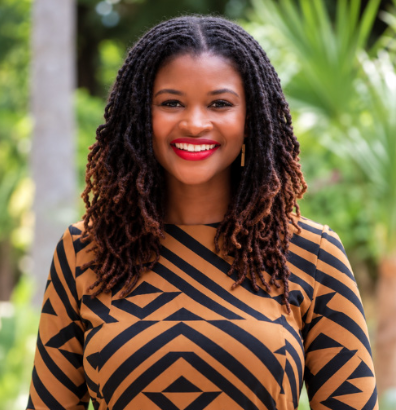
Taryrn T.C. Brown, PhD (she/her), is an assistant professor in the College of Education at the University of Florida. Her work explores how race, class, gender, and place shape educational experiences, with particular attention to youth-led research and university–community partnerships. Her interest in Black educational histories is deeply personal, shaped by her grandparents’ educational experiences in Zimbabwe and questions about whose histories are remembered, documented, and passed on. This connection informs her research interests in methods to recover, reclaim, and connect stories of the past to educational possibilities in the present.