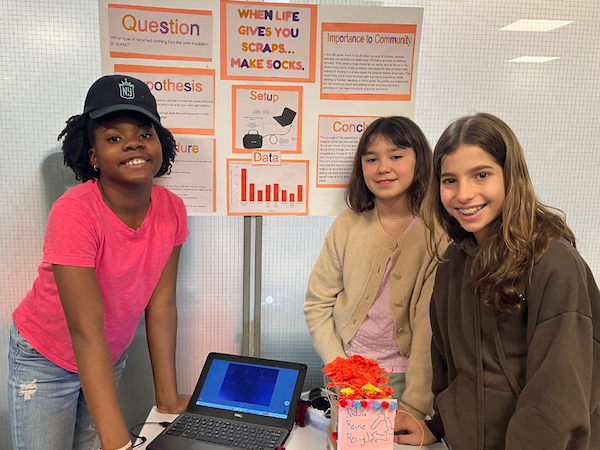
On March 18, Bank Street School for Children welcomed the community to its annual Science Expo, a celebration of curiosity, collaboration, and discovery. The event showcased projects developed and presented by Upper School students in fifth (10/11s) through eighth (13/14s) grade, highlighting the students’ deep exploration of topics that spark their own scientific interests.
Each year, Upper School students work in small groups for six weeks to investigate a scientific question of their own choosing. During this process, they develop procedures, conduct experiments, analyze data, and draw conclusions, ultimately presenting their findings at the expo.
“Expo is an enriching opportunity for Upper School students to become scientists, using tools and techniques to gather data, think critically about evidence and explanations, and communicate their scientific arguments,” said José Guzman, Math and Science Coordinator, School for Children, who organized the expo with the Upper School math and science team. “Through this work, they also build skills in teamwork, problem-solving, and project management, which are essential across disciplines.”
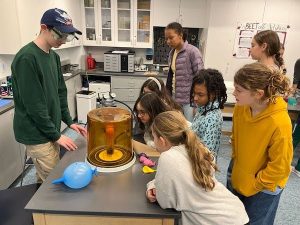 Grounded in Bank Street’s hands-on approach to learning, the program encourages students to experiment with ideas, conduct independent research, and apply the scientific method to real-world contexts.
To begin, students draw on topics from the School for Children’s science curriculum, such as variables and simple machines in fifth grade (10/11s), earth science in sixth grade (11/12s), life science in seventh grade (12/13s), and physical science in eighth grade (13/14s). Then they identify questions they want to explore in collaboration with teachers, who help guide them through the process.
For example, fifth graders (10/11s) often expand on their study of variables and simple machines by testing how changes in load affect objects like parachutes, lifeboats, or catapults.
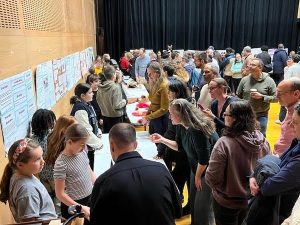 Sixth graders (11/12s) deepen their understanding of earth science by exploring energy. In past years, students designed experiments to help Bank Street evaluate materials for the school’s roof repair, testing reflectivity, durability, and resistance to environmental conditions. Students were highly engaged in the project as they worked together to address a real need at the school and even presented their findings to the Board of Trustees at Bank Street College.
In seventh grade (12/13s), many students further examine life science by testing bacteria and other living processes. This year, several groups conducted experiments that tested Lumbriculus Variegatus, also known as blackworms, to study the effects of toxins.
Last year, a group of students explored how to replicate an experiment from Stanford University that gained widespread attention for using a food dye found in Doritos to make the skin of mice appear temporarily transparent. They reached out to the study’s authors for guidance and adapted the process using chicken, fish, and red meat, ultimately discovering that it worked best with chicken. Through the project, students were able to pursue their own questions, take initiative, and engage deeply in hands-on scientific learning.
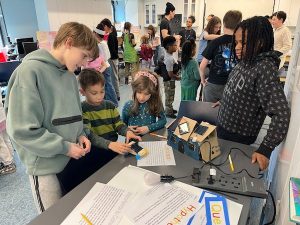
This year, a group of eighth grade (13/14s) students chose to extend their study of physical science by working to replicate single-slit diffraction, a fundamental concept that shows how light behaves as a wave when passing through a narrow slit.
“At times, students get messy, make mistakes, and work through challenges with their team, but in the end, they gain confidence in themselves as learners, deepen their understanding of scientific inquiry, and build essential critical thinking, problem-solving, and communication skills that will support them beyond the classroom,” said José Guzman. “It’s wonderful to see our students at work throughout this program, and it’s one of our favorite times of year.”
Science Expo also serves as a special highlight of the Buddies Program at Bank Street, which pairs younger and older classrooms annually to foster connection and shared learning experiences throughout the school year. At the expo, younger students have the chance to explore projects with their older buddies and share in the excitement of scientific discovery.