On September 8, Bank Street Graduate School of Education welcomed new students at the annual Barbara Biber Convocation. The event, which is a centerpiece of orientation for incoming students, celebrates the start of the school year and provides an opportunity for the College community to engage with seminal thinkers on leading issues in education.
This year’s event featured a keynote presentation on climate change education by Dr. Lauren Madden, an author, researcher, and professor of elementary science education at The College of New Jersey.
The event began with opening remarks from Suzanne McCotter, Dean, Graduate School of Education, who welcomed students, alumni, faculty and staff, and friends. During her introduction, McCotter reflected on the importance of gathering as a community to recommit to shared values and purpose and spoke directly to new graduate students.
“Convocation marks the official start of your journey here. You are joining a long tradition of educators, leaders, and advocates who have come to Bank Street to deepen their knowledge and prepare to make a difference,” she said. “Together, you’re now part of a community that will challenge you, support you, and grow with you as you go on to teach, to lead, and to influence the many settings where education and human development take root.”
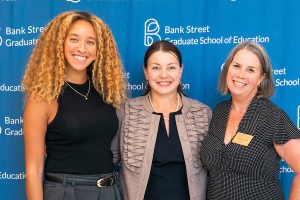 Dr. Madden was introduced by Maryah Greene, GSE ’20, who highlighted Dr. Madden’s extensive work advocating for scientific literacy and the health of our planet through teaching and learning. An educator and children’s book author, Greene’s connection to plants and nature also informs her work. Her book, Good Things, began as her culminating Integrative Master’s Project at Bank Street and follows a young boy who honors his late father by caring for his plants.
Greene said, “Dr. Madden’s work sits at the intersection of so many things that I care about. Education, curiosity, our relationship to the natural world, and most importantly, how we prepare young people to care for it.”
In Dr. Madden’s lecture, she spoke about her work supporting teachers in integrating climate education into their instructional practices and offered insights into how educators can help children develop the skills to understand and respond to climate change. She began her talk by exploring the role of creative thinking and problem-solving in moving us forward as scientists and thinkers.
Dr. Madden led a hands-on activity, challenging participants to think differently as they worked to divide a circle into eight pieces using just three cuts. The exercise demonstrated the importance of approaching problems from different perspectives—with curiosity—and considering possibilities beyond the most immediate or familiar solution.
Next, Dr. Madden discussed critical research on climate change and its impact on children. She referenced the recent floods in Nepal as one example of the growing impacts of climate change around the world. She also noted studies of how heat, pollen, air quality, flooding, and other issues shape children’s health, development, learning, and experiences of their environment.
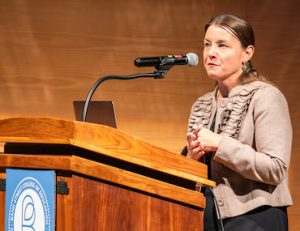
Referencing a recent study by researchers at Columbia University, Dr. Madden said, “We know that when children in early childhood settings are exposed to cleaner air, they perform better cognitively across the board.”
Additionally, Dr. Madden discussed her own research and work with teachers, exploring how educators can help children make sense of complex issues in meaningful, age-appropriate ways. She shared an example of a typical kindergarten classroom with a weather chart, which prompts children to talk about the conditions outside.
“When we ground this work in children’s everyday observations, it becomes innately part of what they think about,” she said. “It’s important that we talk about trends across days and weeks and months, that we center what we’re doing on children’s lived experiences, families, homes, and cultures, and that we joyfully integrate the arts to add salience, build routine, and engage different parts of our brain.”
She added, “Sometimes, the best climate education leadership is simply affirming and naming the best practices our teachers are already engaging in.”
Dr. Madden shared another classroom example of fifth graders who analyzed 10 years of temperature data and used a spreadsheet to compare temperatures above, at, and below average. Students then represented their findings by creating a bead craft, an arts-integrated activity designed to encourage reflection and make space for meaningful conversations.
She concluded by sharing hopeful examples to show children how to solve problems using creative thinking. She highlighted New York City’s wall of oysters project to help mitigate flooding and tidal issues and initiatives like the United Nations-sponsored Youth Climate Summit on Governors Island.
“Children and their teachers have tremendous capacity for building innovative solutions, and our job is to let them and to take them seriously,” she said in closing.
Attendees also had an opportunity to ask questions, such as how to navigate misinformation in conversations about climate change with children. She encouraged educators to ask younger students questions about what they experience, what scientists know and do not know, and what a reliable data source is. For older students, she suggested engaging students in thought experiments by asking questions that prompt deeper thinking.
Dr. Madden is also the editor for Science and Children, the elementary-level journal of the National Science Teaching Association. Her research has been published in many prestigious venues, including What Teachers Want to Know About Teaching Climate Change: An Educator’s Guide to Nurturing Hope and Resilience (Grades K-12).
The Barbara Biber Convocation recognizes the contributions of Barbara Biber to Bank Street and the wider educational community. Dr. Biber was a central figure shaping the institution that evolved from the Bureau of Educational Experiments to become Bank Street College. A keen observer of children and classroom practice, her writings achieved a rare depth of insight and conceptual elegance. As a researcher and scholar, she continuously reexamined and refined her thinking. This lecture memorializes her progressive legacy.