Across the nation, states are working to strengthen the educator workforce amid persistent shortages, budget uncertainty, and policy shifts.
On February 3, Educator Preparation Laboratory (EdPrepLab), an initiative led by Bank Street Graduate School of Education and the Learning Policy Institute to strengthen teacher and leader preparation, hosted its annual Policy Summit to explore how high-retention, clinically rich educator preparation programs can be implemented and sustained for long-term impact.
This year’s virtual summit highlighted strategies for building financially stable, organizationally strong, research-aligned educator preparation systems and examined approaches to strengthen program quality and stability. Convening more than 200 leaders from across the education field, the event created space to share research insights and expert perspectives on sustaining high-quality programs.
“When living in volatile, uncertain times, it is more important than ever to shine the light on bright spots and bring evidence-based examples to a broad audience in order to support the great work being done to prepare and develop the teachers and leaders our students need and deserve,” said Maria Hyler, Director, EdPrepLab, and Director, Washington, DC Office and Senior Researcher, Learning Policy Institute, in her opening remarks.
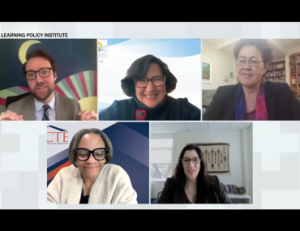 The event began with a panel discussion moderated by Ryan Saunders, Director of State Policy, Learning Policy Institute, featuring Mónica Byrne-Jiménez, Executive Director, University Council for Educational Administration; Linda Darling-Hammond, Chief Knowledge Officer, Learning Policy Institute; Cheryl Holcomb-McCoy, President and CEO, American Association of Colleges for Teacher Education; and Elena Silva, President and CEO, Learning Policy Institute.
The conversation examined how educator preparation programs can ground learning in hands-on, immersive practice through close partnerships with schools and districts and create pathways that support and retain aspiring educators.
“If we are serious about quality educator preparation, we must be serious about having clinical experiences that are deeply rooted in practice and engagement with schools and districts and our partners there, but also intentionally designed and co-constructed between university personnel, as well as school district partners,” said Holcomb-McCoy as she reflected on the important role of her own student teaching and Counselor-in-Training experiences.
In addition, panelists discussed integrating theory and practice, the value of reflection during clinical experiences, and the importance of applied learning. They also addressed the challenge of limited financial supports and emphasized the growing role of teacher residency models in strengthening educator preparation.
For example, Darling-Hammond noted that teacher residency programs, such as those in California, Texas, New Mexico, and New York, strengthen retention, increase workforce diversity by reducing debt through state-funded supports, and produce teachers who, on average, are more effective than those entering through other pathways.
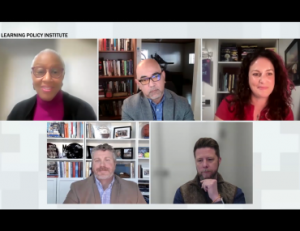 The next panel, moderated by Jennifer Robinson, Senior Researcher and Project Director, Learning Policy Institute, featured a discussion with Enrique Alemán, Jr., Lillian Radford Endowed Professor of Education & Director of the Center for Educational Leadership, Trinity University; Rebecca Hatkoff, Former Director of Teacher Education and Current Research Fellow, Claremont Graduate University; Josh Jones, Director of Educator Preparation Program Field Support & Operations, Texas Education Agency; and Ben Kutylo, CEO, Forward Arkansas.
Representing programs in Texas, California, and Arkansas, the conversation focused on strategies for sustaining high-quality educator preparation programs over time. Panelists shared practical steps they have taken to maintain resources for candidates and program operations, such as by establishing strong partnerships, using data to track progress, and leveraging storytelling to communicate program successes.
“Storytelling is such an important part of partnerships; it’s one of the things that helps build relationships,” said Hatkoff. “When we’re thinking about how to build something organizationally that’s going to be enduring, we have to start gathering the data that we can use to tell compelling stories for different audiences…we have to think about how we are designing a program that’s going to consider all of the people who are in the ecosystem and speak to them.”
Following the panel, Saunders facilitated an informative discussion with Sharon Tomiko Santos, Representative, Washington State Legislature, about how schools and educator preparation programs can sustain strong systems through shifting policies.
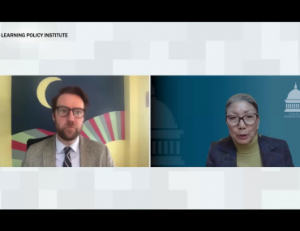 Santos, who has worked as a Washington State policymaker since the late 1990s, shared insights from her decades of service. “Sustainability that is nimble, responsive, and can evolve to meet the needs of our students is where we really want to go,” she said.
She also reflected on earlier remarks from the panelists about applied learning and cultivating lifelong learners, sharing, “We know that applied learning works for our K-12 students, in other words the teachers that we want our teacher candidates to teach to, and why do we think that in our quest for building lifelong learners, that doesn’t also then hold meaning for our adult learners as well?”
To conclude the event, Jessica Blum-DeStefano, Leadership Faculty, Bank Street Graduate School of Education, and Director of Practice and Professional Learning, EdPrepLab, shared closing remarks.
“The summit was a powerful opportunity to bring together educators, policymakers, and program leaders to share insights and strategies for building high-quality, clinically rich programs,” said Blum-DeStefano. “This gathering is essential for advancing our work, fostering collaboration, and ensuring that educator preparation programs are prepared to meet the evolving needs of teachers and leaders and the students and communities they serve.”