On May 26, Bank Street welcomed Kamar H. Samuels, Chancellor, New York City Public Schools (NYCPS), for the 2026 Niemeyer Series lecture titled “Shaping the Future of Public Education in New York City: A Fireside Chat with New York City Public Schools Chancellor Kamar H. Samuels.” The event, which was attended by over 200 educators, graduate students, alumni, and other Bank Street community members, explored both opportunities and challenges shaping the nation’s largest school district.
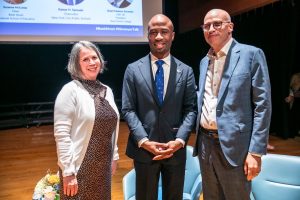 The discussion was moderated by Suzanne McCotter, Dean, Bank Street Graduate School of Education, and featured Samuels alongside Shael Polakow-Suransky, GSE ’00, President, Bank Street College. The dynamic conversation examined critical topics in education today and highlighted a shared vision for building high-quality learning environments that support all children to thrive in the classroom and beyond.
To begin, Lisa Lewin, Trustee, Bank Street College, welcomed attendees by framing the importance of Bank Street’s partnerships with public schools and its unique role as a vital thought partner to the public system.
Next, Samuels presented opening remarks in which he spoke about the city’s focus on building schools that are safe, rigorous, and truly integrated. He also shared a powerful perspective on preparing young people for today’s world, describing his goals around ensuring that students have a strong sense of belonging in schools, can connect across differences, and are fully prepared for the world they will inhabit.
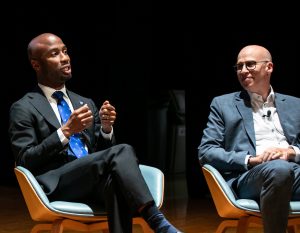
During the fireside chat, Samuels and Polakow-Suransky discussed some of the most pressing issues shaping education today—from building mathematical skills and fluency among students to creating high-quality early learning environments to the rise of artificial intelligence (AI) in classrooms.
“It is critical that, as a part of my chancellorship, we really start a math revolution in our city,” said Chancellor Samuels as he spoke about both ensuring that students deepen their mathematical understanding and that teachers are well-prepared with robust content knowledge through professional learning. “It is not just about seeing it in a classroom, but it’s about the culture that we have about math… the idea that everyone is a math person, and the idea that you can learn.”
Samuels expanded on the importance of supporting students and educators in developing strong math identities. He emphasized the role of culturally responsive, interdisciplinary, and project-based instruction in helping students engage more deeply with mathematics, while also underscoring the need for sustained professional learning for teachers, school leaders, and superintendents across the system.
 The conversation then shifted to early childhood education and the vital need for young children to have access to high-quality learning experiences from their earliest years.
Polakow-Suransky highlighted the importance of teacher recruitment and retention and the need for pay parity for early childhood educators, who work with New York City’s youngest children during the most crucial stage of development.
“One of the most important things for a child is the relationships that they’re forming with adults, and so when someone can’t afford to stay in that job anymore, then that child who formed that relationship, their whole world gets disrupted, and it’s a tremendous setback,” he said. “Figuring out the compensation is one piece, but then the other piece is how do we support the development of those educators so they get really good at their work?”
Samuels echoed support for pay parity among early childhood educators and reflected on his own experience as a parent whose son was cared for by Jamaican women in a home-based daycare setting. He noted that these roles are often held by women of color and emphasized the importance of considering the impact of policies on the workforce as part of broader efforts to build a sustainable universal child care system.
Next, the discussion explored the growing use of AI in classrooms nationwide. Samuels spoke about the importance of approaching its implementation with clear safeguards as schools continue to adapt to new technologies.
“For our system to do well, and for young people to do well, we have to make sure that we have the necessary processes in place to protect people coming into school, to protect really strong thinking, and to ensure that we have the necessary mechanisms for the guardrails,” said Samuels. “We are in the process of really not just engaging, but responding as a system to how we think about age-appropriate learning and age-appropriate connections with AI.”
Polakow-Suransky discussed how educators can use new technologies to support deeper learning and raised important questions about how AI can foster meaningful student engagement.
“How do we think about AI if we’re going to use it as a tool that can actually support and amplify the strengths of our teachers?” said Polakow-Suransky. “How do we look for what teachers need that could make their work easier and more successful and give them room to know their students better to deepen the kind of learning that’s happening?”
The event was interwoven with an audience question-and-answer, and followed by a reception in the lobby that provided attendees with an opportunity for continued conversation and networking.
The Niemeyer Series is an annual event comprising lectures and symposia focused on urgent matters of educational interest. The series is dedicated to the memory of John H. Niemeyer, Bank Street’s second president, for his leadership in helping Bank Street College of Education become a national voice for children beyond practice and into policy.